What is the role of the oceans in Global Warming/Climate Change?


Global Conveyor Belt Ocean Currents

There has been much press and controversy in recent years about global warming or climate change.  Opinions range from doomsday scenarios to absolute disbelief.  As a meteorologist (not climatologist), I say that the truth is somewhere in between these extremes.

Although climatologists and meteorologists debate the merits of global climate change theory, there are some facts that are not disputed by scientists.  The vast majority of scientists agree that the global surface temperatures have increased since the mid-1800s and that humans are adding CO2 to the atmosphere. They also agree that CO2 and other greenhouse gases have a warming effect on the planet.  There is some disagreement, however, on the IPCC claim that there is a 95% certainty that the warming since 1950 has been primarily caused by human activities and just how much the planet will warm during the 21st century. They also tend to argue whether the warming is dangerous and whether or not anything can or should be done to prevent this.

Just what are greenhouse gases anyway?

Source: Smithsonian National Museum of Natural History http://forces.si.edu/atmosphere/images/02_04_06_b.jpg

Greenhouse gasses are those gases that allow the atmosphere to retain heat and thus warm the earth’s surface above what it would be from sunlight alone. The most significant greenhouse gas is water vapor followed by CO2, methane, nitrous oxide and ozone.  Sunlight heats the earth’s surface and that heat is then partially absorbed by greenhouse gases.  Without these greenhouse gases the earth’s temperature would be about 33°C (59ºF) colder than it is now, and our world would likely be a giant snow ball.

Atmospheric CO2 levels over time

The issue today is that some of these greenhouse gases, particularly carbon dioxide and methane have been increasing steadily since the beginning of the industrial revolution. Over the past approximately 150 years the level of carbon dioxide, for example, has undergone a very significant increase of about 40 percent, which cannot be accounted for by natural sources alone.  Carbon dioxide is a powerful greenhouse gas, however, it is present in our atmosphere in very small quantities, about 400 parts per million or 0.04%.

Estimates of CO2’s contribution to the greenhouse effect vary between 9% (3C) to as much as  26% (8.6C) of the total 33C effect.  Given that atmospheric CO2 has increased about 40% over the past 150 years then you might well expect some warming.  Just how much warming is what is in dispute and the best estimates I can find is that doubling CO2 would result in a warming of 0.7C to 1.2C alone or about 0.3C to 0.5C at the current 40% increase level.  Add in various feedbacks and you might double that number.

Natural Variability

The oldest instrumental temperature record comes from Central England and goes back to the 1600s.  In that record there is a sharp warming from 1690 to 1740 and another from 1820 to 1840.  Although we can’t infer too much from this about global temperature variations, the Central England temperature record does illustrate the magnitude of natural climate variability.

Source: Judith Curry Climate Etc. Blog http://judithcurry.com/2011/12/01/the-long-slow-thaw/

Solar activity also varies over time which affects global temperatures. From about 1750-1950 total solar irradiation has been estimated to have increased by about 1 to 1.5 Watts per square meter which can account for 0.2C to 0.3C warming during that 200 year period.  More recently, total solar irradiation has begun to slowly decrease.


Current Pause

Past 10 years NCEP CFSv2 2 Meter Temperature Anomaly C Source: weatherbell.com

Since 1998 there appears to be a pause in global warming not explained by the global climate models as they all predicted a 0.2C per decade warming.  Are the models too sensitive to CO2 or is the treatment of natural variability not modeled well?  Some papers suggest that the pause is not really there, however, the satellite data and the Nation Centers for Environmental Prediction (NCEP) 2 meter temperature data strongly suggest that it is.

IPCC Report

In the most recent (2013) IPCC report it states that “Warming of the climate system is unequivocal, and since the 1950s, many of the observed changes are unprecedented over decades to millennia. The atmosphere and ocean have warmed, the amounts of snow and ice have diminished, sea level has risen, and the concentrations of greenhouse gases have increased“.   

NOAA Global Land and Sea Temperatures

If this is true, we might then ask what caused the strong warming noted from about 1910 to about 1945?  This warming seems very similar to the more recent run-up from the late 1970s to 1998 but occurring prior to the 1950s. In the chart below, you will note that the global temperatures were falling from before 1880 until 1910 and then there were two periods when temperatures were nearly steady or fell slightly. The first pause occurred from the mid-1940s until the late 1970s then starting again from about 1998 until today. The most recent IPCC report, in my opinion, does NOT have a convincing explanation for the large warming between 1910 and 1945, the cooling between 1945 and 1975, and the flat temperatures in the 21st century.

NOAA Reanalysis of SST Anomalies

This suggests to me that there is more in play here than just CO2, since the earlier warming occurred prior to when the majority of CO2 was emitted. Another theory offered by Dr. William Gray suggests that the ocean has multi-decadal and multi-century cycles that may have a significant influence on global warming. Below you see a similar trend with the ocean temperatures. 

The role of the Oceans

The total heat content of the oceans is enormous when compared to the atmosphere.  The atmosphere contains only about 2% of earth’s heat, the land masses another 2% and the oceans, about 93% with the remainder locked up in ice.  Given the above, one must ask just what role the oceans play in global warming?

The ocean-atmospheric interactions are not fully understood and given that the vast majority of earth’s heat is stored in the oceans it is vital to any predictions regarding global warming to understand those interactions.  One of the key questions is how much mixing of cold deep ocean water with warmer surface water varies over time and how does that effect the global temperature.Source: http://hurricane.atmos.colostate.edu/Includes/Documents/Publications/gray2012.pdf

One key ocean cycle that is well documented is the Pacific Decadal Osculation (PDO).  The PDO is a warming and cooling of the Pacific Ocean over a time period of 2-3 decades.   If you plot the PDO index (see above) you will see that the two periods of strong warming (1910 – 1945) and (1978 – 1998) corresponds well with the positive (warm) PDO while the two periods of no global warming or some cooling corresponds well with the periods of negative PDO.

The theory that global warming is driven by ocean cycles seems to have some validity. Increasing atmospheric CO2 does have a role here, however, the longer-term ocean cycles may have an equal or possibly stronger effect. Besides the multi-decadal ocean cycles like the PDO, it is theorized that the Thermohaline Circulation (the global ocean current conveyor belt) runs in cycles that can extend out 100 years or more. As this circulation increases you get more mixing and thus colder sea surface temperatures in the tropical regions and warmer near the poles, however, if slows down you get less mixing and therefore warmer sea surface temperatures in the tropical regions but cooler SST in Polar regions.

Source:  The Physical Flaws of the Global Warming Theory and Deep Ocean Circulation Changes as the Primary Climate Driver – Dr. William Gray   http://tropical.atmos.colostate.edu/Includes/Documents/Publications/gray2012.pdf

How could greenhouse gases warm the oceans?

The downward radiative forcing at the earth’s surface due to increasing CO2 levels is estimated to be about 0.4 W/m2. The oceans, on average, are warmer than the atmosphere so the net energy flux across the ocean/atmosphere interface carries heat from the ocean to the air. Given this and the fact that downward infrared energy cannot penetrate the surface of the ocean more than a few microns how then can back radiation warm the oceans?

The current theory suggests that the downward infrared radiation heats the very thin skin layer of ocean which has the effect of reducing the flow of heat from the ocean to the air, thus allowing the oceans to retain heat over time. Detractors of this theory point out that the increase in skin temperature would increase evaporation rates and thus tend to cool the skin surface largely nullifying any warming effect.

The spike in global temperature for 2014-2015 reflects, in part, a brief return to the positive PDO in late 2013 and as we return to a negative PDO in the coming years the current pause in warming will continue. By 2020  we may have a better idea on how much ocean cycles play in atmospheric warming.

See also Reasoning about climate uncertainty Judith Curry

Fred Pickhardt
Ocean Weather Services


Posted in Climate Change, Meteorology | Tagged , , | 6 Comments

Tropical Storm Kate deepens

2km Natural Color Imagery: NOAA

Tropical Storm Kate continues to deepen as it moves northeastward over the southwestern North Atlantic.  As of 15Z/10th Nov Kate had max winds of about 60 knots however 50 knot or higher winds only extend outward 10-20 NM and only on the East side.


NHC Forecast Track

Kate may continue to strengthen for another 24-36 hours when max winds should peak at 65-75 knots before cooler sea temperatures and increasing wind shear take its toll.

Kate will become fully extra-tropical in about 72 hours.

Posted in Ocean Storms, Tropical Cyclones | Tagged , , , , | Leave a comment

North Pacific Hurricane Force Storm Low

NOAA OPC Surface Analyis 12Z 10 November 2015

A rapidly deepening storm low over the north-central  North Pacific will move east northeastward towards the Aleutian Islands producing winds of 50-65 knots and significant wave heights to 15 meters (about 49 feet).


Below are the 48 hour NOAA surface forecast and wave height forecast.

NOAA 48 Hour Surface Forecast

NOAA OPC 48 Hour Wave Forecast

Posted in Ocean Storms | Tagged , , | Leave a comment

Gulf Low moves northeast while TD develops over Bahamas

12Z NOAA OPC Surface Analysis 08 Nov 2015

The low pressure disturbance over the Gulf of Mexico and the associated frontal trough continues to produce strong to gale force winds north and west of the low and front.  Meanwhile a developing tropical disturbance just north of the Turks and Caicos islands has been producing increasing shower and thunderstorm activity and could become a tropical depression tonight or Monday.

Posted in Ocean Storms, Tropical Cyclones | Leave a comment

TC Megh Update

TC Megh Satellite Image

Tropical Cyclone Megh as of 18Z 07 November 2015 was 465 NM south west of Masirah Island  and was moving westward at 11 knots with max winds of about 90 knots.  Presently hurricane force winds extend outward only about 15 NM.  The latest track forecast places the center of Megh very near or over the Island of Socotra by about 09Z on the 8th.


JTWC Forecast Track


Some weakening will occur with the interaction with Socotra with more rapid weakening likely as dry air is entrained into the circulation  by 36-48 hours.


Posted in Ocean Storms, Tropical Cyclones | Tagged , , | 1 Comment

Storm over Labrador Sea & Gale in the Gulf

48 hour surface forecast NOAA OPC

A developing storm low over the Labrador Sea will produce winds of 40-55 knots  and seas to 30 feet within 480 NM south of the center.  At the same time a develping sub-tropical low over the southwestern Gulf of Mexico will produce strong to gale force winds north and west of the center.

Posted in Ocean Storms | Tagged , , , | Leave a comment

Gales of November

On November 10, 1975 the Great Lakes bulk cargo vessel SS Edmund Fitzgerald carrying a cargo of taconite pellets (iron-bearing flint-like rock used in steelmaking) sank with the loss of all 29 crewmembers in eastern Lake Superior about 17 miles from the entrance to Whitefish Bay, Michigan during a severe storm. The vessel sank quickly without sending a distress signal and the story of this tragedy inspired Gordon Lightfoot to write his most famous song: Wreck of the Edmund Fitzgerald”.

The day before the event, November 9th, an area of low pressure developed over the Southern Plains and moved northeastward and intensified to 1000mb by 1200Z on the 9th over Kansas and later to 993mb over Iowa (0000UTC on the 10th). A Gale warning was issued by the National Weather Service for Lake Superior at 1939UTC on the 9th.

At 1915UTC on the 9th, the Edmund Fitzgerald departed from Superior, WI bound for Detroit. A short time later, the Arthur M. Anderson left Two Harbors, MN and was also headed eastbound. Both masters decided to take a northerly route to keep in the lee of the forecasted northerly gale winds.

Edmund Fitzgerald Most Probable Track - American Meteorological Society

Edmund Fitzgerald Most Probable Track – American Meteorological Society

At first, the Arthur M. Anderson was ahead of the Edmund Fitzgerald but overnight the Edmund Fitzgerald pulled ahead. At 0700UTC on the 10th the National Weather Service issued a Storm Warning for Lake Superior as the now deepening low was moving northeastward reaching a position near Marquette, Michigan by 1200 UTC (982mb).  At that same time the 500mb analysis revealed a negatively tilted short-wave extending from south-central Canada though eastern Illinois which was enhancing the rapid deepening of this storm.

November 10, 1975 NOAA Surface Analysis

At 2030UTC on November 10th, the master of the Edmund Fitzgerald (Capt. McSorley) reported that a fence rail was down and that a couple of vents were lost and that the vessel was developing a list so he decided to reduce speed in order to allow the Arthur M Anderson to close the distance between them. Just 40 minutes later, Capt. McSorley reported that both of his radars were out of order and asked the master of the Arthur M Anderson if they could assist with navigation.

During the period between 1800 UTC November 10th and 0000 UTC November 11th the low moved northeast to near James Bay deepening to 978mb causing westerly to northwesterly winds to increase over Lake Superior. At 2139UTC the Coast Guard reported that the radio beacon at Whitefish Point was not functioning. Between 2200 and 2230 UTC Capt. McSorley reported that the vessel was now listing badly and that they were taking heavy seas over the deck. At 0010 UTC on the 11th, Capt. McSorley reported “We are holding our own” but this was the last message sent by the doomed vessel. 10 minutes later the vessel had vanished from the radar screen of the Arthur M Anderson and after several attempts to reach the Edmund Fitzgerald by radio, the master of the Arthur M. Anderson informed the U.S. Coast Guard that the Edmund Fitzgerald may have suffered a casualty.

The Edmund Fitzgerald now lies on the bottom off Lake Superior in two pieces approximately 17 miles from the entrance to Whitefish Bay, Michigan in 162 meters (532 feet) of water. All 29 crew members aboard were lost with the ship.


Storm Reanalysis

A reanalysis of this event was done in 2005 by NOAA, National Weather Service utilizing the Regional Atmospheric Modeling System (RAMS). The model run started at 0000 UTC 9 November 1975 and ran through 0600 UTC 11 November 1975.

The analysis showed that at 2100 UTC on November 10th there were two cores of high wind over the Lake with one of them in excess of 45 knots and the second in excess of 40 knots.  The highest winds occurred over the southeastern part of Lake Superior where the Edmond Fitzgerald was heading.  Wave heights increased to near 6 meters and by 0000 UTC November 11th and winds were exceeding 45 knots over most of southeastern Lake Superior.

Edmund Fitzgerald Wave Heights 01Z Nov 11 1975

Edmund Fitzgerald Wave Heights 01Z Nov 11 1975

The Edmund Fitzgerald sank at the eastern edge of the area of high wind where the long fetch (distance that the wind blows over water) produced significant wave heights (average of the highest 1/3 of waves) to over 7 meters (23 ft) by 0000 UTC and to over 7.5 meters (25 ft) at 0100 UTC with a maximum significant wave of 7.8 meters (26ft). Given a significant wave of 7.5 meters (25ft) about 1 in 100 waves could reach over 11 meters (36ft) and one out of 1000 waves could have been as high as 14 meters (46ft). Since the vessel was heading east-southeastward, the waves were quartering to following which resulted in heavy rolling.

At the time of the sinking he Arthur M Anderson reported NW winds of 50 knots which matched the model output of 47 knots. The model showed that the maximum sustained winds occurred between 0000 and 0100 UTC at 60- 65 knots with gusts upwards of 75 knots. Just a couple hours later (0300 UTC) conditions had eased to under 45 knots.

The National Transportation Safety Board determines that “the probable cause of this accident was the sudden massive flooding of the cargo hold due to the collapse of one or more hatch covers. Before the hatch covers collapsed, flooding into the ballast tanks and tunnel through topside damage and flooding into the cargo hold through non-weathertight hatch covers caused a reduction of freeboard and a list. The hydrostatic and hydrodynamic forces imposed on the hatch covers by heavy boarding seas at this reduced freeboard and with the list caused the hatch covers to collapse.

Contributing to the accident was the lack of transverse weathertight bulkheads in the cargo hold and the reduction of freeboard authorized by the 1969, 1971, and 1973 amendments to the Great Lakes Load Line Regulations.”

Sources:
1. Reexamination of the 9–10 November 1975 “Edmund Fitzgerald” Storm Using Today’s Technology BY THOMAS R. HULTQUIST, MICHAEL R. DUTTER, AND DAVID J. SCHWAB; American Meteorological Society  2006 http://www.glerl.noaa.gov/pubs/fulltext/2006/20060016.pdf

2. US Coast Guard National Transportation Safety Board Bureau of Accident Investigation (1978) 

https://www.uscg.mil/history/WEBSHIPWRECKS/EdmundFitzgeraldNTSBReport.pdf

3. S.S. Edmund Fitzgerald Online:  
http://www.ssefo.com/

NOAA News: http://www.noaanews.noaa.gov/stories2006/s2633.htm

Fred Pickhardt


Posted in Weather History | Tagged , | Leave a comment

Here we go again

TC Megh

Tropical Cyclone Megh has formed over the Arabian Sea and at 00Z 06 November was centered about 515 NM east of Socotra Island and was moving towards the WSW at about 7 knots.  Max winds are estimated to be about 40 knots, however, conditions favor strengthening to hurricane force during the next 24 hours with the center forecast to reach near or over the Island of Socotra by about 09Z 08 November.


See Latest Forecast Track

Posted in Ocean Storms, Tropical Cyclones | Tagged , , , , | Leave a comment

TC Chapala Final Update

TC Chapala Forecast Track

02 November 2015: Tropical Cyclone Chapala has been weakening as it approaches the coast of Yemen. As of 18Z 02 November, Chapala had max winds of 90 knots with hurricane force winds extending outward 35-40NM. Chapala is forecast to make landfall at west-southwest of Mukalla about 06Z 03 November with max winds of about 65 knots (minimal hurricane force).

Wind Analysis

Posted in Ocean Storms, Tropical Cyclones | Tagged , , , | Leave a comment

About Optimum Ship Routing

A short history of weather routing

The earliest form of ship routing may have been when early humans used the prevailing easterly winds to sail from island to island in the Pacific or when Arab traders sailed portions of the  Indian Ocean based on the prevailing monsoons.

By the time of Columbus, Portuguese sailors had taken advantage of their knowledge of the prevailing trade winds and helped Portugal become a powerful maritime power. When Columbus set forth on his voyage of discovery he used the prevailing trade winds to carry his fleet to the New World and then took the more northerly route for his return taking advantage of the prevailing westerly winds.

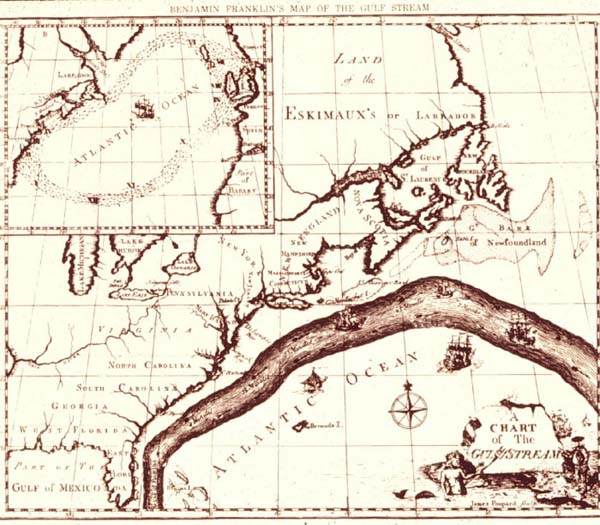
Benjamin Franklin, in 1786 noted that “vessels were “sometimes retarded and sometimes forwarded in their voyages by currents at sea”. He knew that ships coming from Falmouth to New York took a fortnight longer than those coming from London to Rhode Island.

Franklin consulted a Nantucket sea captain regarding this and was told that the cause was the Gulf Stream. (Nantucket captains knew of the Gulf Stream because of the whaling trade.) That same captain marked the stream on a chart along with directions for avoiding it.


The Gulf Stream by Benjamin Franklin. Courtesy of NOAA Photo Library

Modern ship routing ideas began during the early stages of WWII when the US Navy established the “Naval Meteorology and Oceanography Center” at the Naval Air Station in Norfolk. in 1958 “Optimum Track Ship Routing” (OTSR) was started to provide tailored safety and cost saving routing services to all ships utilized by the military for long duration open ocean voyages.

Commercial marine weather routing had it start in the 1950’s when Howard Kaster, a meteorologist for United Airlines, started a company called “Pacific Weather Analysis Corporation” which later evolved into Ocean Routes in 1967 under Ray Maier and Bill Dupin.

Other pioneers of commercial ship routing in the 1960’s included Bill Kaciak the founder of “Weather Routing Inc.”, TV weather man Louis Allen who started “Allen Weather Corp” and “Bendix Marine Science Services” under Robert A Raguso which began routing operations in 1968.

What is Optimum Ship Routing?
Optimum ship routing is the art and science of developing the “best route” for a ship based on the existing weather forecasts, ship characteristics, and special cargo requirements. For most transits this will mean the minimum transit time that avoids significant risk to the vessel, crew and cargo. The goal is not to avoid all adverse weather but to find the best balance to minimize time of transit and fuel consumption without placing the vessel at risk to weather damage or crew injury.

Route planning normally will start be reviewing the appropriate Pilot Chart Atlases and Sailing Directions (Planning Guides) to determine the normal weather patterns, weather risks and prevailing ocean currents. The Routing Service then reviews recent weather patterns and weather forecast charts to determine the most likely conditions during the course to the voyage.

A preliminary routing message is transmitted to the master of a vessel prior to departure with a detailed forecast of expected storm tracks, an initial route proposal with reasoning behind the recommendation and also the expected weather conditions to be encountered along that route. This allows the master to better plan his route and offers an opportunity to communicate with the service any special concerns that he or she might have due to special cargo requirements or ship condition. Once the vessel departs, the vessel’s progress is monitored closely with weather and route updates sent as needed.

Fred Pickhardt

http://oceanweatherservices.com/

Posted in Meteorology, Weather History, Weather Wisdom | Tagged , | Leave a comment