The Flying Enterprise story of Man vs. the Sea

Flying Enterprise Image Credit Leigh Bishop www.deepimage.co.uk

During Christmas Week, 1951, began an incredible sea story involving a WWII era cargo vessel named the Flying Enterprise and her captain, Kurt Carlsen.  Captain Carlsen was a Danish-born seaman that began his sea career at the age of 14. He became master of his first ship at the age of 22 with the Danish-American company American Export-Isbrandtsen Lines which was a New York based US-flag shipping company from 1919 to 1977, offering both cargo and passenger ship services. In 1977 it declared bankruptcy and was acquired by Farrell Lines.

The SS Flying Enterprise was a 6,711 ton Type C1-B ship. She was built in 1944 as SS Cape Kumukaki for the United States Maritime Commission for use in World War II. The ship was sold in 1947 and then operated in scheduled service under the name Flying Enterprise.

UK Met Office Surface Analysis 06Z Sunday 23 Dec 1951

The Storm

On December 21, 1951, The Flying Enterprise departed Hamburg, Germany bound for New York with a cargo that included 1,300 tons of pig iron, 900 tons of coffee and 10 passengers. From the departure out of Hamburg through the English channel the vessel encountered heavy fog.

Late on the 23rd of December, as the Flying Enterprise was steaming southward in fog towards the English Channel, a weak surface low of 1016 mb was noted over Michigan.

US Sfc Analysis 1330EST Dec 23 1951 NOAA


UK Met Office Surface Analysis 06Z Monday 24 Dec 1952 Christmas Eve


As the vessel steamed though the English Channel on Christmas Eve, the Flying Enterprise first encountered heavy weather due to a strong low pressure area that was moving well northward of Ireland and Scotland.  The heavy weather continued through Christmas Day and the day after Christmas as the vessel passed out of the Channel and into the North Atlantic as gale force winds increased to storm force 10.  During the night of Dec. 26, Capt. Carlsen decided to heave the vessel to as winds continued to increase and approach force 12 (hurricane).  At the same time the weak disturbance far to the west moved out over the western North Atlantic and began to deepen reaching 1006 mb by 12Z Christmas Day as it passed southward of Cape Race, Newfoundland.  Twenty-four hours later, at 12Z on December 26th, the western low was rapidly deepening into a 974mb storm low and was racing east-northeastward near 50N 24W.

NOAA Reanalysis Dec 26 1951 12z

UK Met Sfc Analysis 06Z-Thursday-27-Dec-1951

Rapid deepening continued through the 26th and by 06Z on Dec. 27th the now violent storm low had reached 944 mb near 55N 12W,  just as it passed to the north of the Flying Enterprise position.   Note:  Between Dec 25/12z to Dec 27/06z the storm had deepened 62mb in just 42 hours!.

The Flying Enterprise Encounters the Storm

As the storm center passed north of the Flying Enterprise that morning, the vessel encountered what was described as “a very high sea” at position 50-41N 15-26W (about 400 miles west of Lands End). Several load bangs where heard (like the firing of a gun) throughout the ship and an examination determined that the vessel had suffered two main fractures.  The first began at the after port corner of #3 hatch and ran across the deck and back to the accommodation ladder opening at the side and ran down the side to the longitudinal riveting at the base of the sheer strake.

On the starboard side the crack ran from the forward corner of the deck house straight across to the accommodation opening and from there down to the riveting on the opposite side. The cracks were estimated to be between 1/8 and 3/8 inches in width.  A smaller crack ran from the after starboard corner of the #3 hatch toward the side of the ship and was estimated to be 18 inches long.  At the time, Capt. Carlsen reported force 12 winds and 40ft seas.  A measurement of the pressure gradient near the vessel suggests winds were at least 60kts which would be consistent with a violent storm BF 11 (56-63 kt wind and 30-45 ft waves) and could have easily reached force 12 at times.

Given the ship’s position it is apparent that the captain had set out on a minimum distance great circle route from Bishop Rock towards Nantucket.  Had Carlsen chosen a more southerly wintertime track, perhaps the vessel would not have encountered conditions that severe.

In an effort to reduce the strain on the now damaged vessel, Capt. Carlsen turned the ship southwestward so that the wind and sea were broad on the bow and later more southerly bringing the wind almost abeam.  During this time period, Carlsen had the crew fill the cracks with cement then run cable from the bitts at #3 hold to bitts aft in order to bind the deck together.

UK Met Sfc Analysis 06Z Friday 28 Dec 1951

Flying Enterprise Listing Heavily – Image Credit Leigh Bishop www.deepimage.co.uk


As the Flying Enterprise proceeded south keeping the seas on the starboard beam, Capt. Carlsen concluded that he must put in at either an English or French port or head to the Azores for repairs. During the night of the 27th into the morning of the 28th as yet another storm passed to the north, the vessel experienced rolling of up to 20 degrees. At about 1130 on the morning of the 28th the vessel was hit broadside by another high wave which rolled the vessel between 50-70 degrees to port shifting the cargo and causing the vessel to return to a permanent list of about 25 degrees.  The list increased gradually and eventually the engine lost lubrication oil due to the list which resulted in the loss of both boilers forcing Capt. Carlsen to have his radio operator send out an SOS.

Flying Enterprise just prior to sinking – Image Credit Leigh Bishop www.deepimage.co.uk

The Rescue Attempt

The SOS was answered by several ships and the passengers and crew were rescued in heavy seas by lifeboats from the US Navy troop ship USS General A W Greely and the steamerSouthland on Dec. 29th.  Because of the heavy list, the lifeboats on board the Flying Enterprisecould not be launched and both passengers and crew were forced to jump into the cold North Atlantic before being recovered by the lifeboats. One middle-age passenger drowned during this operation, otherwise, all of the remaining passengers and crew were successfully rescued.
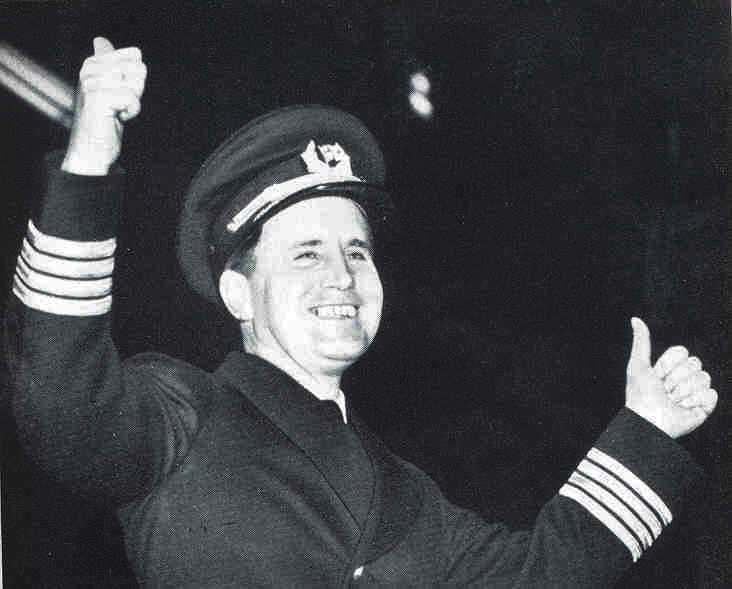
Capt Carlsen

Captain Carlsen chose to remain with his ship in order to wait for the arrival of a salvage tug.  The salvage tug Turmoil finally arrived on January 3rd some 5 days after the passengers and crew were rescued but it quickly became evident that it would be impossible for Capt. Carlsen, alone aboard a heavily listing vessel (now listing at 60 degrees), to secure a tow line himself.

After several unsuccessful attempts to secure the tow line, the 27-year-old chief mate on the Tug Turmoil, Kenneth Dancy, leaped from the deck of the tug onto the railing of the Flying Enterprise on one of the very close approaches made by Capt. Dan Parker of the Turmoilduring one of the failed attempts to secure the tow line.  With Dancy’s help, however, a tow line was secured and the long tow back towards Falmouth England began.

While the tug and tow approached the English coast on January 8th the weather started to deteriorate.  On January 9th, just 45 miles from Falmouth, heavy seas parted the towline.  The Flying Enterprise drifted eastward while several attempts were made to re-secure another towline but all attempts were unsuccessful.   At 1536 on the afternoon of January 10, 1952 as the Flying Enterprise, now listing at 90 degrees and taking water down the stack.  Both Dancy and Carlsen jumped into the sea from off the stack and were taken aboard the Turmoil where they watched the Flying Enterprise sink under the waves, stern first at 1609.

By now this ongoing sea drama was being reported around the world and Capt. Carlsen had become world-famous for staying on his crippled freighter. Captain Carlsen received a hero’s welcome when he came ashore at Falmouth and later was awarded the Lloyd’s Silver Medal for meritorious service in recognition for his attempts to save his ship.

Carlsen received a ticker-tape parade in New York City on January 17th.   A few months later he took command of the Flying Enterprise II, passing up several lucrative offers from Hollywood for his story.  Carlsen, and his ordeal aboard the Flying Enterprise, is the subject of  an excellent the book “Simple Courage: a True Story of Peril on the Sea” by Frank Delaney.

NYC ticker tape parade

Coast Guard Report

The US Coast Guard inquiry found that the damage, abandonment and loss of the vessel were caused by circumstances beyond the control of the master and crew.  The fracture sustained while hove to in head seas was not a direct cause of the vessel’s loss but merely an indirect contribution to the loss.

The Coast Guard did remark about the stowage of the pig iron cargo in #2 hold and noted that it was not leveled out as was the pig iron in #4 hold but was stacked in a pyrimid shape.   The report stated that this did constitute a certain hazard as to shifting, however, this type of stowage  was a common practice at the time and had been sanctioned by the shipper, underwriter, owner and the master.   It was also believed that the empty condition of the double bottoms aft and the deep tanks in #4 hold had an appreciable effect on the great degree of list which the vessel took.

References and Links


Wikipedia article

Wikipedia article on Henrik Kurt Carlsen    

Wikipedia article on American Export Lines 

Wikipedia article on Type C1 Ships 

Frank Delaney, Simple Courage – A True Story of Peril on the Sea  

Beaufort Wind Scale: NOAA 

UK Met Office

US Coast Guard Marine Board of Investigation: Flying Enterprise

News Reels

British PATHE Newsreels 1952 – Flying Enterprise


Posted in Meteorology, Ocean Storms, Weather History | Tagged , , , , , , , | 21 Comments

North Atlantic Storm

Developing Storm - Image credit NOAA OPC

A rapidly deepening low over the western North Atlantic is forecast to produce winds of 50 to 70 knots within 360 NM west of the center during the next 24-48 hours building significant wave heights to over 40 feet (12 meters).

The area of highest winds and seas will be along the main shipping routes so this will likely effect some arrival times for ships transiting from Northern Europe to the US East Coast.

NOAA OPC 48 HR Surface Forecast

Posted in Ocean Storms | Tagged , , , | Leave a comment

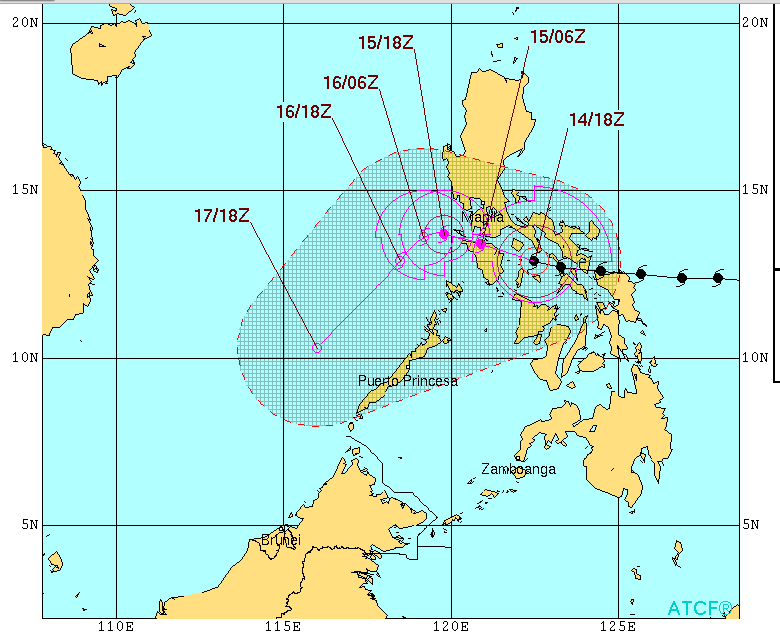
Typhoon Melor moves through Philippines

Joint Typhoon Center forecast track for Typhoon Melor

Typhoon Melor at 21Z 14 Dec 2015 was located 134 NM southeast of Manila, Philippines and was moving west-northwest at 08 knots with max winds of 90 knots and significant waves of up to 35 feet (10.7 meters) over open ocean. Melor  is forecast to turn west and move out over the South China Sea by 15Z on the 15th, then turning southwestward and weakening.

Posted in Tropical Cyclones | Tagged , , | Leave a comment

Friday Update Hurricane North Pacific Storm

Western North Pacific storm developing off Japan 12Z 11 Dec 2015

A rapidly deepening storm low off the coast of Japan Friday will continue to intensify rapidly into a large hurricane force storm as it tracks northeast towards the Bering Sea over the weekend. Max winds are forecast to reach up to 80-85 knots producing significant wave heights to 17 meters (about 56 feet).

This is a dangerous storm that will adversely affecty shipping along the North Pacific northern routes for the next few days.

48hr NOAA OPC Surface forecast 12Z 13 Dec 2015

48hr NOAA OPC Significant wave forecast 12Z 13 Dec 2015

Posted in Ocean Storms | Tagged , , | Leave a comment

North Pacific Hurricane force Storm update

A developing storm low east of Japan Dec 10-11th will deepen rapidly into an intense hurricane force storm enroute to the Aleutians by the 13th with winds forecast to 75 knots and significant wave heights to 16 meters (about 52 feet). Expecting a significant impact to to vessels using the northern North Pacific routes.


96 Hour NOAA OPC surface forecast 12Z 13 Dec 2015

Posted in Ocean Storms | Tagged , , | Leave a comment

Hurricane Force Storm likely over North Pacific

Surface wind forecast NOAA GFS model

Surface wind forecast NOAA GFS model 00Z 13 Dec. image: weatherbell.com

A developing storm low will move off the coast of Japan around 06Z 11 December, then is forecast to deepen rapidly enroute to the Aleutians with winds reaching hurricane force by 00Z 13 December. Significant wave heights could build to 15 meters (about 50 ft). This system will adversely affect shipping lanes across the northern North Pacific over the weekend.

Learn more about hurricane force extra-tropical storms,


Posted in Ocean Storms | Tagged , , | Leave a comment

Hurricane force storm forecast over northeast North Atlantic

A rapidly deepening storm low over the northeastern North Atlantic will deepen rapidly from 978 mb to 940 mb over the next 24-36 hours with winds increasing 50-65 knots.

North Atlantic 00Z 07 Dec. 2015 surface analysis NOAA OPC

Update 07 Dec 2015  – The weather is active in the North Atlantic as evident in this ASCAT high resolution image showing a hurricane force low (winds ≥ 64 knots) south of Iceland.  (image NOAA)

NOAA ASCAT Wind Analysis 07 Ded 2015


Learn more about hurricane force extra-tropical storms,

Posted in Ocean Storms | Tagged , , | Leave a comment

1950 Super Storm Remembered

1230 UTC 25 Novemeber 1950

I was only 2 years old at the time but still have some hazy distant memory of a storm that may have initiated my interest in meteorology later in life. I was living in Passaic, NJ at the time in an apartment complex called Barry Gardens. My Dad at the time was a merchant seaman and away from home for extended periods. I can remember being scared of the sound of the howling wind outside and the darkness caused by the loss of power that night.  The November Superstorm, along with the Hurricane Hazel in October of 1954 may have planted the weather bug in my brain.

The November 1950 storm caused widespread flooding and wind damage along the East Coast while inland areas were coping with heavy snowfalls and very low temperatures. The storm developed over North Carolina then deepened rapidly into an “East Coast Bomb” as it tracked northward into Pennsylvania before turning northwest and headed towards Lake Erie and later curving southwest and then east across Ohio.

00Z Surface and 500mb Analysis 26 November 1950 Image: NOAA

The storm caused havoc along the East Coast as the high winds coincided with the high tide creating widespread flooding along the New Jersey, Long Island and New England Coasts. Wind gusts were clocked at 94 mph in New York City, 108 mph at Newark Airport, 110 mph at Concord, NH and 160 mph at the top of Mt. Washington, NH!

While strong winds and rain pelted the East Coast, farther inland heavy snow and blizzard conditions prevailed. Nearly 28 inches of snow fell in Pittsburgh, about 36 inches in Steubenville, OH and up to 62 inches was reported at Coburn Creek, WV.  Strong temperature contrasts were reported across relatively short distances during the height of the storm. While Buffalo, NY was reporting rain and temperatures in the 50’s, Pittsburgh about 200 miles to the south was reporting heavy snow and temperatures falling into the single digits.

Image credit NOAA NWS

The cause of all this appears to have been a strong upper level low that moved rapidly from south-central Canada late on the 22nd of November as an Omega Block was developing over the North Atlantic Ocean south of Greenland.  By late on the 23rd, Thanksgiving Day, the upper low was intensifying across Wisconsin and was en-route to North Carolina as the strong Omega block held over the North Atlantic.

Early on the 24th a surface low pressure area was centered over the Great Lakes with a strong frontal trough extended southeastward across the Appalachians then south-southwestward into the Gulf of Mexico. As the upper low continued to intensify and drop southeastward towards North Carolina, a secondary surface low developed over the Eastern Carolinas.

500MB Analysis 00Z 24 November 1950

The conditions were now set for a “Coastal Bomb”. The surface low deepened very rapidly over Eastern North Carolina late on the 24th tracking northward to near Washington, DC by the early morning hours of the 25th. At the same time a strong High-pressure area was nearly stationary over Eastern Canada. This caused an unusually strong pressure gradient over the North Eastern States and very high winds.

With strong high pressure to the northeast the surface low turned northwestward tracking across Pennsylvania and reached Lake Erie by late in the evening of the 25th. Thereafter, as the upper level low lifted northward, the surface system began to weaken but not after devastating a large portion of the East Coast and Midwest. The storm, according to various accounts, took between 160 and 383 lives and caused up to $70 million in damages.

500 MB Analysis 15Z 25 November 1950

On a positive note, one interesting fact is that this was the first storm ever forecasted using NWS numerical model programs. The more recent March 1993 storm was well predicted by computer models based on information gathered from the November 1950 event.


Fred Pickhardt

Sources:

The Thanksgiving Weekend Storm of 1950 – by Robert E. Kistler, NOAA/NWS/NCEP/EMC, Camp Springs, MD; and L. Uccellini and P. J. Kocin (Includes a good audio-visual presentation)
http://ams.confex.com/ams/84Annual/techprogram/paper_73168.htm

MONTHLY WEATHER REVIEW NOVEMBER 1950
THE DESTRUCTIVE STORM OF NOVEMBER 25-27,1950
CLARENCE D. SMITH, JR.
WBAN Analysis Center, U. S. Weather Bureau
http://docs.lib.noaa.gov/rescue/mwr/078/mwr-078-11-0204.pdf

Great Appalachian Storm of November 1950
From Wikipedia, the free encyclopedia
http://en.wikipedia.org/wiki/Great_Appalachian_Storm_of_November_1950

NOAA NWS Daily Weather Map
http://docs.lib.noaa.gov/rescue/dwm/1950/19501125.djvu


Posted in Meteorology, Ocean Storms, Weather History | Tagged , , , , | 1 Comment

Recent SOI values suggest rapid end to El Nino

Current SOI

The SOI measures the difference in surface air pressure between Tahiti and Darwin. Sustained positive SOI values above about +8 indicate a La Niña event while sustained negative values below about –8 indicate an El Niño.

Positive values indicate enhanced easterly winds over the tropical Pacific which tends to cool sea surface temperatures (La Nina).  Prolonged negative values indicate reduced easterlies which allow warming or El Nino conditions to develop.

Since October the SOI has reversed from a strong negative signal to mostly positive which suggests that the current El Nino is set to weaken rapidly.

Data source https://www.longpaddock.qld.gov.au/

Posted in Meteorology | Tagged , , | Leave a comment

Strong High Pressure to Build off East Coast

96 Hour NOAA OPC Forecast Chart

Building high pressure will be moving off the New England and Canadian Maritime coasts 25th and 26th which will produce a large area of strong to gale force winds over the southwestern North Atlantic.


Posted in Ocean Storms | Tagged , , | Leave a comment