Hurricane Force Storm forecast offshore US East Coast

NOAA OPC Surface foreast 12 UTC 04 March 2016

A deepening low forecast off the US East Coast near Cape Hatteras by 1200 UTC 04 March will produce winds of 45 TO 60 KT by Friday morning increasing to hurricane force winds offshore later Friday into early Saturday.

Posted in Ocean Storms | Tagged , , , , | Leave a comment

Hurricane force storm expected Central and Eastern North Pacific

NOAA OPC Surface Forecast 00 UTC 01 March 1, 2016

A rapidly deepening low over the west-central North Pacific  by Monday will reach hurricane force by 00 UTC 01 March over the central North Pacific before moving ENE over the eastern North Pacific during the 2nd with storm force or higher winds as far south as 30N latitude.  This system will produce significant wave heights to 13 meters (about 43 feet).

NOAA OPC Surface Forecast 12 UTC 02 March 2016NOAA OPC Wave Height Forecast 12 UTC 02 March 2016NOAA OPC Wave Height Forecast 12 UTC 02 March 2016

Posted in Ocean Storms | Tagged , , , | Leave a comment

Gulf of Lion Storm Brewing

NOAA OPC Surface Analyis 18 UTC 27 February 2016

A developing storm low over the western Mediterranean Sea will result in gale force winds increasing to storm force over the Gulf of Lion by Monday.

GFS 10 M wind forecast 12 UTC Monday 29 February 2016

Posted in Ocean Storms | Tagged , , | Leave a comment

Do Ocean Currents account for much of the current Global Warming?

Strong vs. Weak MOC Image credit Dr. William Gray

One Hypothesis out there comes from William M. Gray Professor Emeritus Department of Atmospheric Science Colorado State University:   “A slowing down of the global ocean’s Meridional Overturning Circulation (global conveyor belt) is the likely cause of most of the global warming that has been observed since the latter part of the 19th century. Shorter multi-decadal changes in the MOC are hypothesized to be responsible for the more recent global warming periods between 1910-1940 and 1975-1998 and the weak multi-decadal cooling periods between 1945-1975 and 2000 to the present. This current weak cooling is projected to go on for the next couple of decades”.

When the MOC (or THC) is stronger than average there is more upwelling of cold water in the South Pacific and Indian Oceans, and an increase in global rainfall of a few percent occurs. This causes the global surface temperatures to cool. The opposite occurs when the MOC (or THC) is weaker than normal. There is less upwelling of cold water, global rainfall is reduced a few percent and the global surface temperature warms“.

Meridional Overturning Circulation (MOC)

Ref:   The Physical Flaws of the Global Warming Theory

Ref:  Exceptional twentieth-century slowdown in Atlantic Ocean overturning circulation

Posted in Climate Change, Meteorology | Tagged , | Leave a comment

TC Winston turns southward after hitting Fiji

IR Satellite Photo TC Winston 1345Z 22 Feb 2016

After passing over Fiji, TC Winston at 1500Z 22 February was located about 348 NM West of Suva, Fiji and was moving slowly southward with max winds of about 90 knots. Winston if forecast to move south-southwestward and weaken starting on the 23rd and decreasing below hurricane strength by the 25th due to increasing wind shear.

JTWC Forecast Chart

Posted in Ocean Storms, Tropical Cyclones | Tagged , , | Leave a comment

Intense TC Winston to affect the Islands of Fiji and Vanua Levu

IR Satellite photo via JTWC SATOPS

TC Winston as of 21 UTC 19 February continues to move westward over the South Pacific about 164 NM east-northeast of Suva, Fiji, now with max winds of 145 knots. Winston is moving over very warm ocean water with additional strengthening likely during the next several hours.  The current forecast track takes Winston just north of Fiji and near or over the southern tip of Vanua Levu about 06 UTC 20 February with max winds near 160 knots with gusts to 195 knots possible!

Radar View

JTWC Forecast Track for TC Winston


Posted in Ocean Storms, Tropical Cyclones | Tagged , , , | Leave a comment

TC Winston bears down on Fiji

JTWC Forecast Track TC Winston

TC Winston continues to strengthen and at 06UTC 19th was located about 330 NM east of Suva, Fiji and was moving west at 12 knots.  Max winds are estimated to by near 125 knots,  Winston remains in favorable conditions for further development peaking at 130-140 knots during the next 12-18 hours. The center of Winston will reach or be very near Fiji about 12Z-18Z 20th.

NOAA IR Satillite Image 1530Z 19 Feb. 2016

Recent satellite images have Winston at Dvorak T number 7.0 suggesting max winds of 140 knots at 15Z  19 Feb 2016!

Latest JTWC Track Forecast

Posted in Ocean Storms, Tropical Cyclones | Tagged , , , | Leave a comment

Video shows captain of Anthem of the Seas discussing storm

Video posted by Sean Ferguson on You Tube

RE Anthem of the Seas: This video was broadcast to all the staterooms on the RCTV internal channel the day after the storm. I recorded it with my iPhone and published it here for those not on the ship to see. Video credit Sean Ferguson.


You Tube Link   https://www.youtube.com/watch?v=Jo0SLwupq10

Comments: It appears from this video that the Captain was anticipating 40-50 knot winds with 4-5 meter seas. The track shown in the video passes near Cape Hatteras then continues SSW towards the east coast of Florida. Looking at the NOAA forecast chart issued shortly after midnight Saturday night it appears that winds of 40-50 knots and 4-5.5 meter seas were forecast near Hatteras, however, just southward winds were forecast at 50-65 knots with seas 6-7 meters (21-24 feet) by early Sunday evening with the storm intensifying rapidly.

The master indicated winds were 150-160 knots but best evidence so far is that peak winds were in the 65-75 knot range late Sunday afternoon into early Sunday evening which would have been severe enough. Given sustained winds of 65-75 knots it is likely that wind gusts could have been in the range of 80-95 knots (90-110 mph)!  These conditions are not uncommon with intense winter storms over the North Atlantic, however, this is likely an extreme event for this particular location.

Additionally, the captain indicated that due to the storm caused delay and a forecast for more gale winds east of Georgia they decided to turn the ship around and head back to Bayonne, NJ with no mention of engine problems.  (One of two diesel-electric azipod units used to propel Royal Caribbean’s Anthem of the Seas sustained damage as the ship battled an intense hurricane-force storm off Cape Hatteras, North Carolina on Sunday).


Posted in Ocean Storms, Weather History | Tagged , , | Leave a comment

Was the hurricane force storm off the US East Coast forecast correctly last weekend?

Anthem of the Seas

The 168,666 ton Anthem of the Seas departed Bayonne, New Jersey last Saturday  with about 4,500 guests and 1,600 crewmembers for a scheduled 7-day roundtrip to the Bahamas.  During Sunday the vessel was sailing southward to a schedule port call at Port Canaveral, Florida when it encountered a large, hurricane-force storm off of Cape Hatteras, North Carolina. Continue reading

Posted in Ocean Storms, Weather History | Tagged , , , , , | Leave a comment

Hurricane Force storm rapidly developing off US East Coast

NOAA OPC Surface Forecast 12 UTC 8 Feb 2016

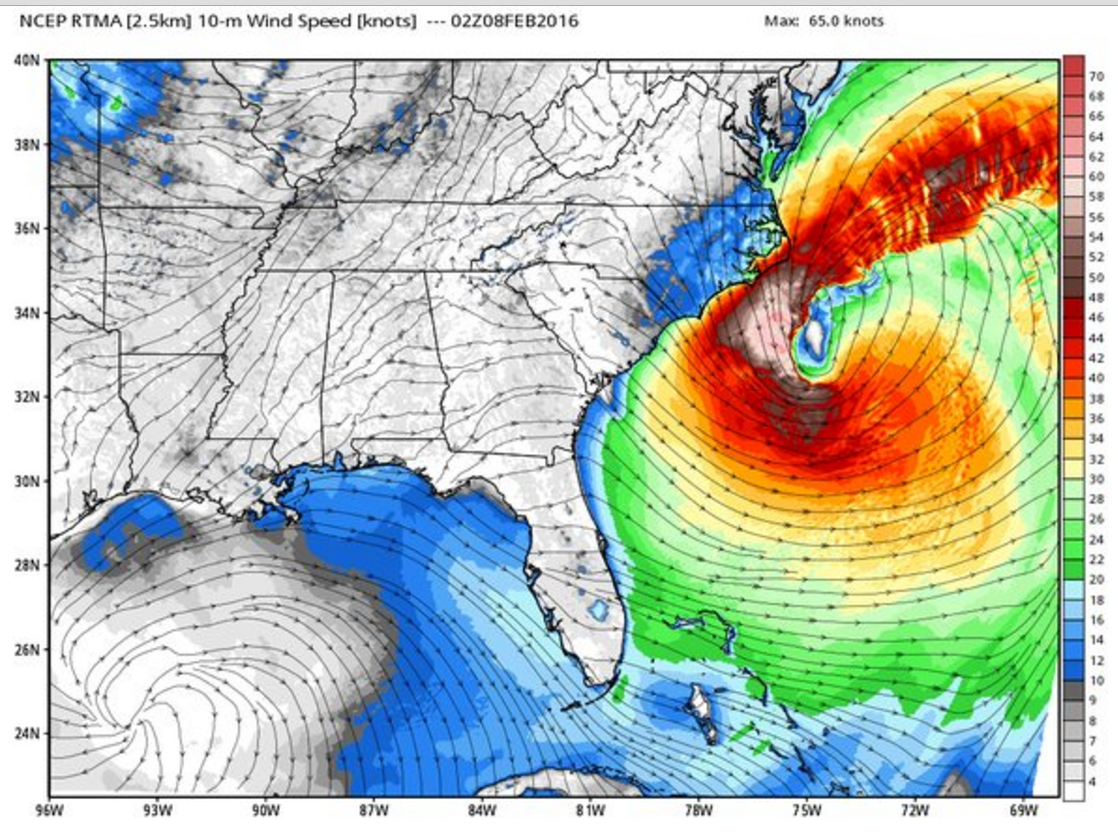
A rapidly deepening storm low off the US East Coast will produce winds of 50-65 knots and seas to 11.5 meters (about 38 feet)during the next 18-36 hours.

Update 02 UTC already at hurricane force winds.

NCEP RTMA Hi Res model 02 UTC 8 February peak 65 knots - Image credit weatherbell.ocm

Posted in Ocean Storms | Tagged , , , , | Leave a comment