Hurricane Matthew over Windward Passage to head towards Bahamas and Florida

NOAA Satellite image Hurricane Matthew over the Windward Passage

NOAA Satellite image Hurricane Matthew over the Windward Passage

Hurricane Matthew at 2100 UTC has weakened slightly to 120 knots maximum winds due to the interaction of nearby land. Hurricane force winds extend outward 40 NM while 50 knot or higher winds extend outward 50-60 NM.  Gale force winds extend out about 150 NM to the southeast and 60 NM to the northwest.

Once Matthew moves into the Bahamas, the environment is favorable for the hurricane to maintain category 4 status for the next 2 days. Some weakening is likely beyond day 3 due to increasing wind sheer.

Estimated wind field via http://rammb.cira.colostate.edu/

Estimated wind field via http://rammb.cira.colostate.edu/

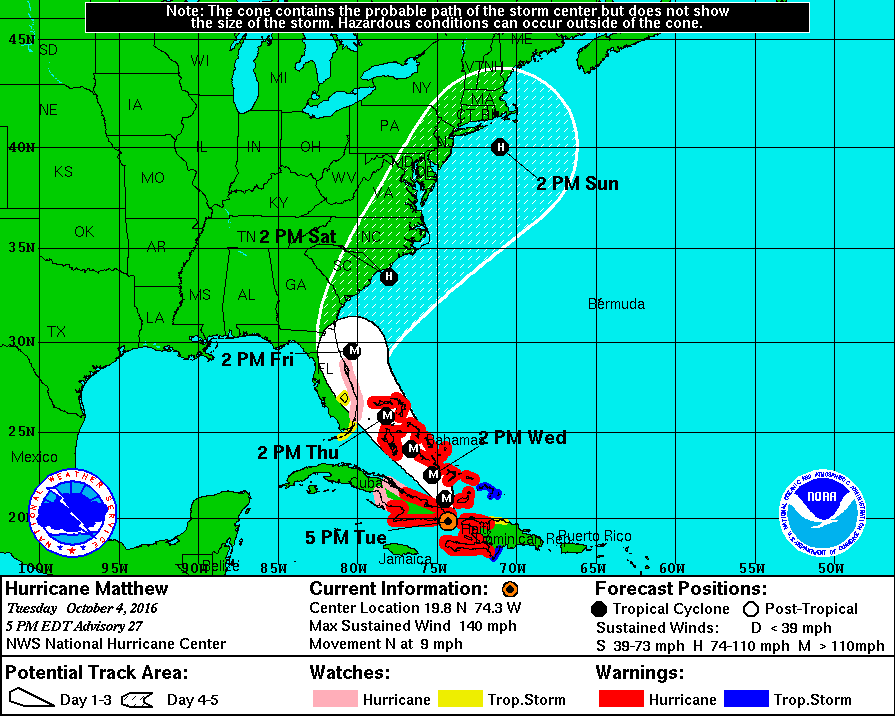
Matthew is moving towards the north at about 8 knots, however, most models show Matthew turning more towards the northwest as it moves across the Bahamas Wednesday and Thursday then approaches the Florida East Coast during Thursday and Friday. Thereafter, a turn to the north then northeast should bring the center of Matthew near the SC/NC coasts on Saturday.

Matthew is likely to produce devastating impacts from storm surge, extreme winds, heavy rains, flash floods, and/or mudslides in portions of the warning areas in Haiti, Cuba, and the Bahamas.

NOAA NHC Forecast Track

NOAA NHC Forecast Track

Posted in Uncategorized | Tagged , , , , , , , | Leave a comment

Super Typhoon Chaba to head towards South Korea and Japan

Satellite Image Super Typhoon Chaba

Satellite Image Super Typhoon Chaba

Super Typhoon Chaba over the western North Pacific at 1500 UTC was centered abut 69 NM west-southwest of Okinawa, Japan and was moving towards the N-NW at 9 knots. Maximum winds are estimated to be 145 knots with hurricane force winds extending outward only 20 NM to the south and 25 NM to the North. 50 knot or higher winds extend outward 35 NM to the southwest and 60 NM to the northeast. Maximum significant wave height is about 42 feet (about 12.8 meters).

Forecasts suggest that Chaba will move northward for another day or two before turning northeast to east-northeast passing between South Korea and Japan on the 5th while slowly weakening.

JTWC Forecast Track

JTWC Forecast Track

Posted in Ocean Storms, Tropical Cyclones | Tagged , , , , , | Leave a comment

Hurricane Matthew Sunday update

NOAA IR Satellite Image

NOAA IR Satellite Image

Hurricane Matthew has weakened slightly since Saturday due to dry air entering the circulation from South America.  Currently max winds are about 120 knots with hurricane force winds extending 30 NM to the northeast and 15 NM to the southwest.  Damaging 50 knot or higher winds extend outward  60 NM to the northeast and 30 NM to the southwest.  Maximum significant wave height is estimated to be 36-40 feet (11-12 meters).

NOAA NHC Forecast Track

NOAA NHC Forecast Track


Matthew is forecast to move northward while slowly weakening passing east of Jamaica and near or over the extreme southwestern tip of Haiti Monday night, passing over the Windward Passage and the easternmost tip of Cuba early Tuesday.

After passing northward of Cuba, models suggest a turn towards the N-NW as it moves across the Bahamas, however, there is still uncertainty in the track and intensity after 72 hours.

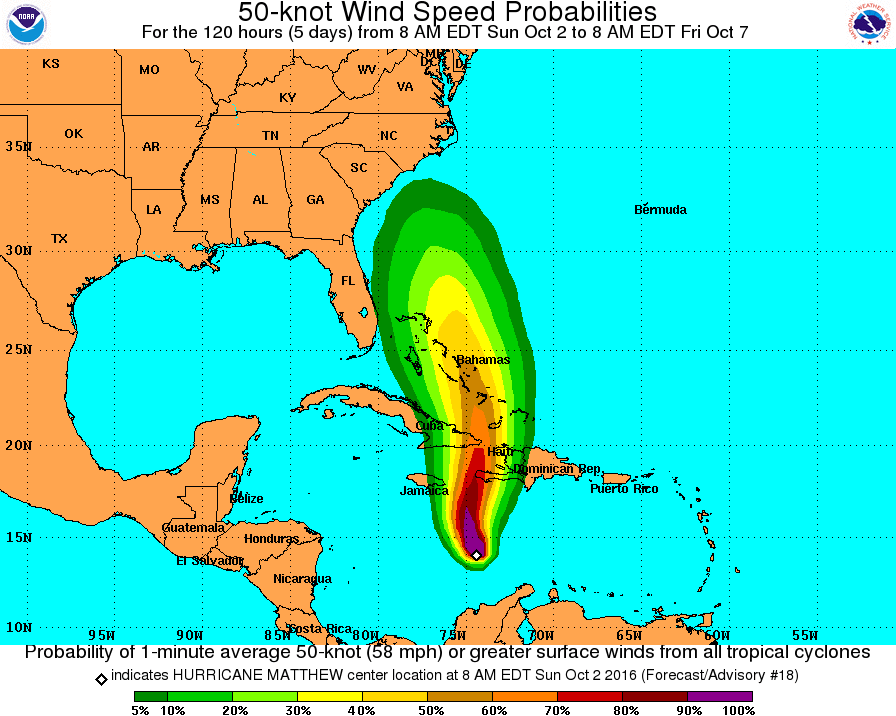
NOAA NHC Risk for encountering at least 50 knot winds.

NOAA NHC Risk for encountering at least 50 knot winds.


Posted in Uncategorized | Tagged , , , , , , | Leave a comment

Major Hurricane Mathew

matthew2Hurricane Matthew continues to intensify and currently has max winds of 100 knots.  Matthew is moving towards the WSW at about 10 knots with hurricane force winds extending outward 20-30 NM and 50 knot or higher winds outward 25-30 NM to the south and 80 NM to the north.

Matthew is forecast to continue WSW to W for another 24 hours then turn NW to NNW during Sunday and Monday bringing the center close to or over eastern Jamaica Monday morning then across eastern Cuba Monday night and early Tuesday with max winds of 100 knots, possible higher.

NHC Forecast Track

NHC Forecast Track

After passing across eastern Cuba most models take Mathew northward across the Bahamas to off Cape Hatteras, however, there is some risk that it could move closer the east coast of Florida.

Hurricane Model Forecast Tracks

Hurricane Model Forecast Tracks via tropicaltidbits.com

Posted in Ocean Storms, Tropical Cyclones | Tagged , , , , , | Leave a comment

Yet another Typhoon threatens Taiwan

NOAA IR Satellite Image

NOAA IR Satellite Image

Typhoon Megi over the western North Pacific at 2100 UTC 24 September 2016 was about 544 NM SSE of Kadena,  Okinawa and was moving WNW at about 12 knots with max winds 75 knots and max significant wave height of about 25 feet (7.6 meters).  Hurricane force winds extend outward about 30-40 NM and 50 knot winds extend outward 60 NM to the southwest and up to 120 NM to the northeast.

Megi is forecast to continue on a WNW track and will intensify to about 110 knots max winds as it nears the coast of Taiwan.  The current forecast track has Megi making landfall over southern Taiwan between 0600-1200 UTC on the 27th.

JTWC Forecast Track

JTWC Forecast Track

Posted in Uncategorized | Tagged , , , , , | Leave a comment

Remembering The Great Tampa Gale of 48

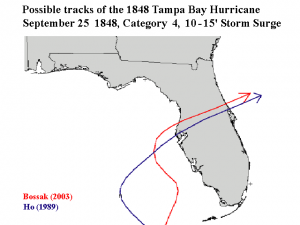
Possible Tracks for the 1848 Tampa Hurricane. image courtesy of James B. Elsner, Department of Geography Florida State University

Possible Tracks for the 1848 Tampa Hurricane. image courtesy of James B. Elsner, Department of Geography Florida State University

It has been quite a while since a major hurricane has made a direct landfall in the Tampa Bay area but back before the Civil War two hurricanes hit the Tampa Bay area within about 2 weeks of each other.

In 1848  Tampa was a small village of fewer than 200 people, outside of the military garrison located at Fort Brooke (now down town Tampa).  Earlier that year, the county of Hillsborough had appointed Louis Covacevich and Samuel Bishop as the first pilots of the port of Tampa.  In May, the lighthouse at Egmont Key started operations and just two weeks before the first hurricane hit, Tampa’s first school opened on September 11th. (1)

 Fort Brooke (Image Credit - The Tampa Bay History Center

Fort Brooke (Image Credit – The Tampa Bay History Center)

The first of the two storms was probably the most intense hurricane ever to affect Tampa and occurred on Monday, Sept. 25th.  It came to be known as “The Great Gale of 48” and was described by survivor, William Henry Whitaker, as “the granddaddy of all hurricanes.” (7)

The September 1848 storm was an intense hurricane with estimated maximum winds of between 101-135 mph at landfall. (2)(5).  The storm moved north-northwestward off the west coast of Florida causing damage at Charlotte Harbor before it turned toward the northeast and then east-northeast making landfall near Clearwater during the early afternoon of Sept. 25th  with an estimated minimum pressure of about 945mb.(4)

Storm Accounts
The evening before, the winds began to gust from the northeast with occasional showers. It was reported by residents that the bay “glowed with phosphorescence almost bright enough to read by”. By 9am Monday morning the increasing southeasterly winds began to veer southerly and later southwesterly as the tide rose rapidly and thewind blew with unprecedented violence”. The violent winds continued through the afternoon only subsiding sometime between 6 and 8 PM that evening. The maximum winds in Tampa (Ft. Brooke) occurred between 1 PM and about 4 PM on the 25th as the wind veered southerly to southwesterly. (1).

The barometer at Ft. Brooke fell from 1013mb at 9 PM on the 24th to a minimum of 954mb during the peak of the storm on the afternoon of the 25th.(3)  A letter form Maj. R.D. S. Wade at Ft. Brooke stated that “all the wharves and most public buildings at the fort were destroyed and that flooding was exceptionally great but no lives were lost”. The post surgeon reported that the tide rose to 15 ft. above low water and that the water rose very fast between 1000 and 1400”. It was also reported that all of the vessels in the port were driven up the river and destroyed by the high winds and storm surge. (2)  Other accounts stated that great waves covered most of the islands within the bay and that the garrison at Fort Brooke was almost completely inundated by water and waves pounded and destroyed the barracks, horse shed and other structures and only the tops of the trees could be seen.  The recently opened lighthouse at Edmont Key was badly damaged and had to be rebuilt.

Fort Brooke was one of the largest military establishments in the United States when this map was made in January, 1838. Image Credit Tampa Bay History Center

Fort Brooke was one of the largest military establishments in the United States when this map was made in January, 1838. Image Credit Tampa Bay History Center

After passing Tampa the hurricane moved east-northeast across Florida passing off the Florida East Coast just north of Cape Canaveral. Many of the navigation routes were reported filled with sand and closed to traffic making any charts created prior to 1848 useless. (2)

Every building on the bay and river was destroyed except for the Palmer Hotel which was badly damaged. At the Garrison the church on the beach, the soldier’s barracks, the Indian agent’s office and the Ferris residence, store and warehouse were wrecked.  According to Juliet Axtell, the wife of the Army Chaplain, “there were not more than four or five buildings left standing” and she concluded in a letter that “Tampa was no more.”(1)

Just two weeks after this major hurricane nearly destroyed Tampa, a second hurricane visited the Florida West Coast on October 11-12th.  A ship 20 miles southeast of Cape St. George reported northeast hurricane force winds causing its lee rail under water for eight hours.  In Tampa this storm was not as intense as the earlier one; however, it did cause a storm surge to about 10 ft in Tampa Bay.(2)

An interesting legend regarding the 1848 Hurricane is that it created a new pass through a barrier island which was discovered by a reformed pirate named John Levique. Today the pass is known as John’s Pass.

References:

  1. Brown, Cantor. Tampa Before the Civil WarThe Tampa Bay History Center, 1999
  2. Barnes, Jay. Florida’s Hurricane History, The University of North Carolina Press, 1998
  3. Ludlum, David M. Early American Hurricanes 1492-1870, American Meteorological Society.
  4. Ho, F. P. (1989), Extreme Hurricanes in the Nineteenth Century, NOAA Tech. Memo. NWS HYDRO-43, 134 pp., National Oceanic & Atmospheric Administration, Washington, D.C.
  5. Dunn, G. E., and B. I. Miller, 1964: Atlantic Hurricanes, Louisiana State University
  6. Bossak & Elsner Plotting Early Nineteenth-Century Hurricane Information
  7. Grismer, Karl, The Story of Sarasota.The Florida Grower Press. Tampa, 1946


Posted in Ocean Storms, Tropical Cyclones, Weather History | Tagged , , , , , | Leave a comment

Karl to pass near Bermuda

NOAA IR Satellite Image TS Karl

NOAA IR Satellite Image TS Karl

TS Karl is becoming better organized with max winds currently at 50 knots.  Conditions will become more favorable and Karl could reach hurricane strength within 24 hours.   Karl is moving northward at 10 knots with gale force winds extending outward about 100 NM but only on the north side.


On the forecast track, the center of Karl should pass near or to the east of Bermuda late tonight or early Saturday.  The risk for encountering hurricane force winds in Bermuda at the moment is very low (less than 3%). The risk for damaging 50 knot winds is about 20% while the risk for gale force winds is high at about 70%.

NOAA NHC Forecast Track

NOAA NHC Forecast Track

Posted in Ocean Storms, Tropical Cyclones | Tagged , , , , , | Leave a comment

Typhoon Malakas Closes in on Japan

Typhoon Malakas Satellite Image

Typhoon Malakas Satellite Image

Typhoon Malakas at 0300UTC was located 262 NM SSW of Sasebo Japan and was moving ENE at 11 knots with max winds of 105 knots.  Hurricane force winds extend outward 40-45 NM with 50 knot our higher winds extending outward 65-75 NM.

Malakas is forecast to make landfall over Kyushu, Japan about 1400 UTC on the 19th with max winds of about 90-100 knots. Malakas will move along the coast of Japan weakening to a tropical storm prior to passing over or near Tokyo Bay about 1800UTC on the 20th.

JTWC Forecast Track

JTWC Forecast Track

Posted in Ocean Storms, Tropical Cyclones | Tagged , , , , , , | Leave a comment

Typhoon Malakas nears Taiwan


IR Satellite image Typhoon Malakas

IR Satellite image Typhoon Malakas

Typhoon Malakas continues to approach Taiwan, however, the center is expected to pass about 50-60 NM east of Taipei between 0600-1200 UTC on the 17th with max winds of 110-120 knots.  At that time hurricane force winds will extend outward only 20 NM west and 30 NM east with 50 knot or higher winds extending outward 50 NM west and 70 NM east.  Max significant wave height is currently estimated to be about 38 feet (11.6 meters).


Malakas is forecast to turn northward after passing Taiwan then northeastward towards Japan but will start to weaken after 18-24 hours.

JTWC forecast track for Typhoon Malakas

JTWC forecast track for Typhoon Malakas

Posted in Ocean Storms, Tropical Cyclones | Tagged , , , , , , | Leave a comment

Typhoon Malakas heading towards Taiwan

JTWC Satellite Photo

JTWC Satellite Photo

Typhoon Malakas over the western North Pacific was moving towards the northwest at 12 knots with max winds of 90 knots. The radius of 50 knots or more winds are 45NM to the southwest and 60 NM to the northeast. The maximum significant wave height is estimated at 35 feet (10.7 meters).

Current forecast track brings the center of Malakas near the northern tip of Taiwan about 1200 UTC on the 17th with max winds between 100 and 115 knots.

JTWC Forecast Track

JTWC Forecast Track

Posted in Ocean Storms, Tropical Cyclones | Tagged , , , , , | Leave a comment