Omega Block developing over eastern North Atlantic

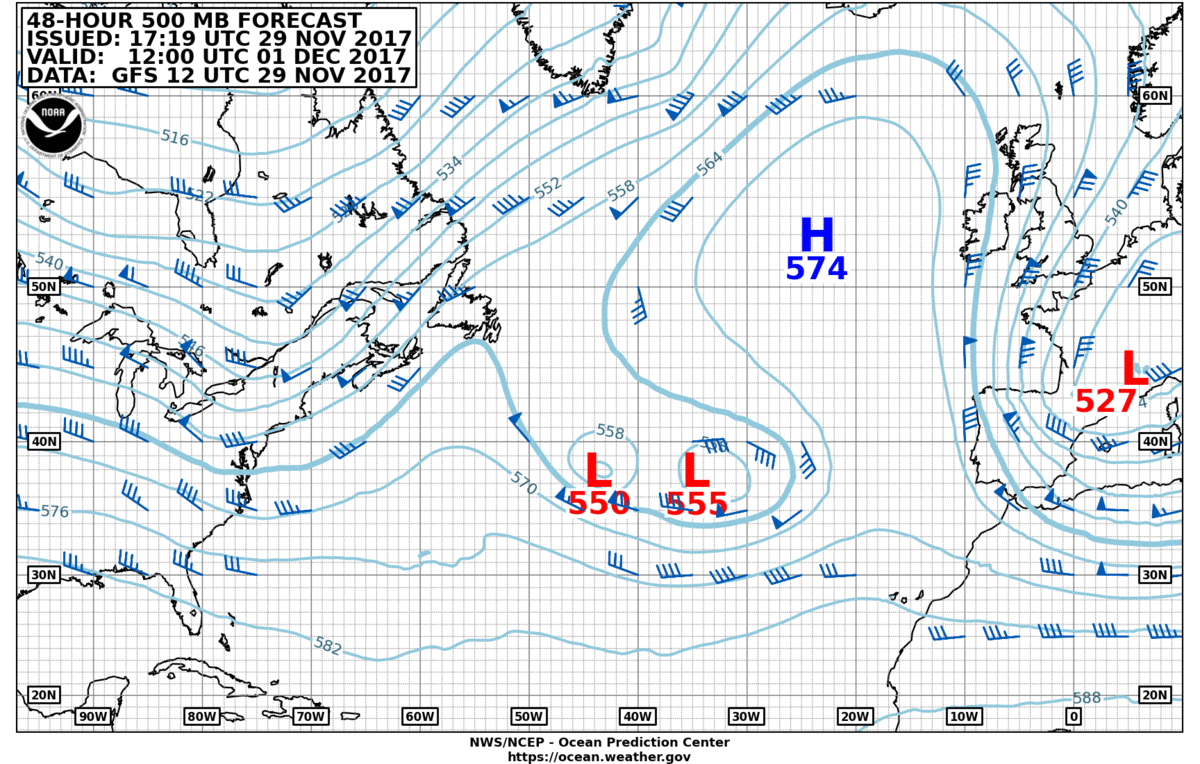
Omega  block on  500 mb forecast chart

NOAA OPC 48 hour 500 mb forecast chart

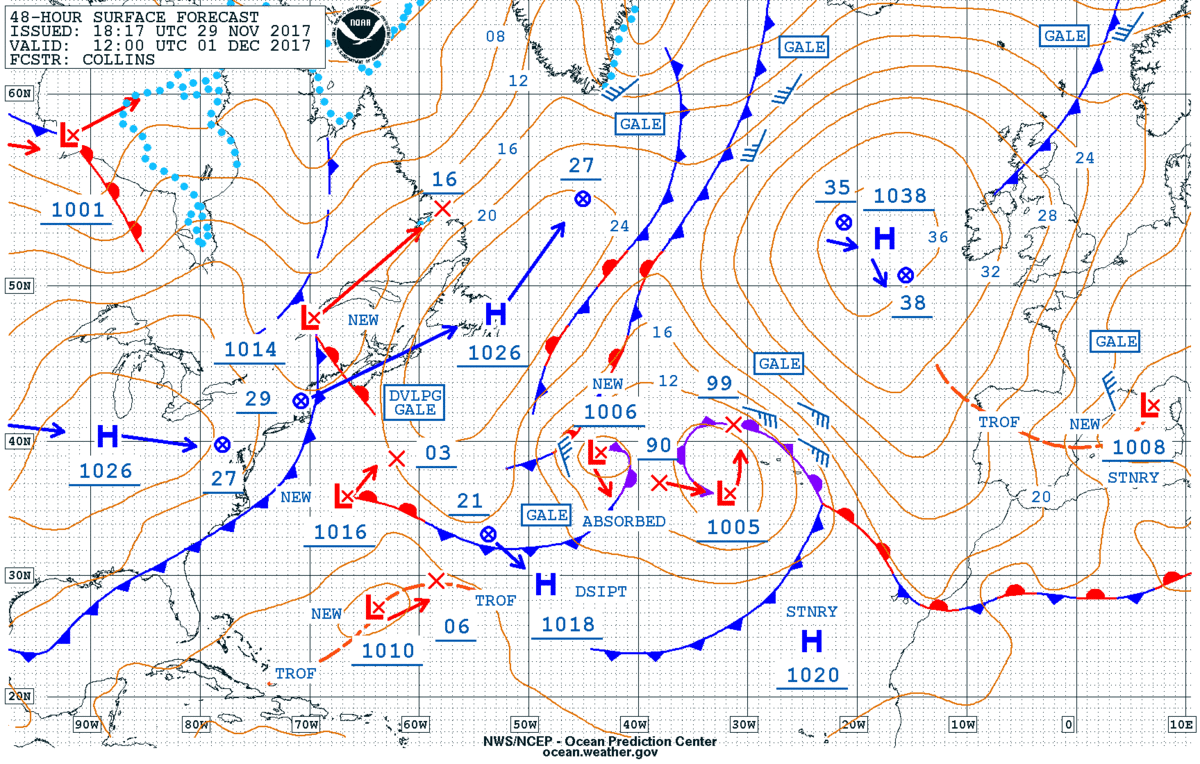
The current North Atlantic upper-air pattern is developing  an Omega block over the northeastern North Atlantic. This pattern gets its name because this upper air pattern looks like the Greek letter omega (Ω). Omega blocks tend to have two cut-off lows with one blocking high sandwiched between them. They also tend to be large in size, producing a persistent surface pattern.

Often the cut-off upper lows tend to dig southeastward into the lower-left portion of the omega which can, in turn, force the omega pattern to extend farther northward.  This disrupts the normal southwest to northeast storm  tracks which can allow options for minimum distance great-circle weather routes during winter from North Europe ports to US East Coast Ports.

Learn more about using the 500mb chart for weather routing.

NOAA OPC 48 hour surface forecast showing blocking high pressure

NOAA OPC 48 hour surface forecast.


Posted in Meteorology, Weather Routing | Tagged , , , | 2 Comments

Hurricane Force storms affecting North Pacific shipping


NOAA OPC North Pacific surface analysis

NOAA OPC North Pacific surface analysis

Two Hurricane Force storms affecting North Pacific shipping


An intense 950 mb storm low over the north-central North Pacific is moving east with winds of 50-65 knots and seas to 46 feet (14 meters) within 480 NM south and southwest of the center.

A second developing complex low system to the west is moving eastward and is forecast to deepen to 953  mb with a secondary low center to the south over the next 18-24 hours. Winds forecast 50-65 knots with seas to 37 feet (about 11 meters) south and southwest of the lows.

The stormy combination will likely adversely affect ships transiting the North Pacific north of 40N for the next couple of days.

NOAA OPC North Pacific Forecast Chart

NOAA OPC North Pacific Forecast Chart

Posted in Ocean Storms | Tagged , , , | Leave a comment

What’s the weather like cruising the Caribbean during December?

December Pilot Chart

Wind

Over the Caribbean during December winds tend to be mostly from the east or northeast averaging forces 4-5 (11-21 knots), except the eastern Caribbean where the wind tends to averaging force 4 (11-16 knots). Over the Gulf of Mexico winds tend to be more variable but still averaging mostly forces 4-5 (11-21 knots). The risk for gale force or higher winds is low, generally 1 % or less, except for the westernmost Gulf of Mexico where the gale risk is 2-3%. 

Waves

Over the Caribbean waves generally average 3-7 feet, however, the risk of encountering rough 8 foot or higher seas is about 10% over the Gulf of Mexico and ranges from 10 to 30 percent over the central and western Caribbean with the highest risk concentrated north of the Colombian coast. The eastern Caribbean tends to average 2-5 ft waves and the risk for rough seas of 8 ft or more occur less than 10% of the time.

Temperature 

Air temperatures during December average 27-28 C (80-83 F) across the Caribbean, 16C-22C (61-72 F) over the northern and western Gulf of Mexico and 22-25 C (72-77 F) across the Bay of Campeche and southern Gulf of Mexico.

Most destinations in the Caribbean experience afternoon high temperatures 27-31 C (80-88F) with late night and early morning lows 21-25 C (70-77 F) It will be somewhat cooler in the northern Bahamas where afternoon highs tend to be around 25-26 C (77-79 F) and lows 20-21 C (68-70 F)

Sea Temperature

Sea surface temperatures range from 26-28C (79-82 F) in the Caribbean, 18-24C (64-75 F) over the northern and western Gulf of Mexico and 24-27C (75-81 F) in the Bay of Campeche and southeastern Gulf of Mexico.

Pilot Chart for the North Atlantic (Caribbean Section) depicting air and sea temperatures

Pilot Chart for the North Atlantic (Caribbean Section) depicting average air pressure and temperatures


RAINFALL

Wettest destinations are the Virgin Islands, Puerto Rico, Martinique and St Lucia where you can expect 15-20 days with some rainfall while driest destinations include the Bahamas, Cuba, and Jamaica where rain falls on 10 days or less.

Tropical Cyclones  

Tropical cyclone activity is rare this month.

Learn more about Ocean Weather Services

Posted in Climatology, Cruise Weather | Tagged , , , , , | 4 Comments

Dangerous West Pacific Storm Developing


NOAA OPC Surface Analysis

NOAA OPC Surface Analysis

Post-Tropical Hurricane Force Storm Lan will move rapidly northeast and transfer its energy to a developing storm low that will move towards the southwestern Bering Sea and western Aleutian islands.


This developing storm will deepen very rapidly to a dangerous 938 MB hurricane force storm creating winds of 55 to 75 knots and seas building 36-56 feet (11-17 meters) within 360 NM SE and 420 NM SW of the center within 24-36 hours.  This system will create a dangerous situation for ship traffic steaming along northern routes.

Learn more about the winter hurricanes

NOAA OPC Wave Height Forecast

NOAA OPC Wave Height Forecast

NOAA OPC Forecast 0000UTC 25 October 2017

NOAA OPC Forecast 0000UTC 25 October 2017

Posted in Ocean Storms | Tagged , , , , , , | Leave a comment

Intense Hurricane Force North Atlantic Storm

NOAA OPC Surface Analysis

NOAA OPC Surface Analysis

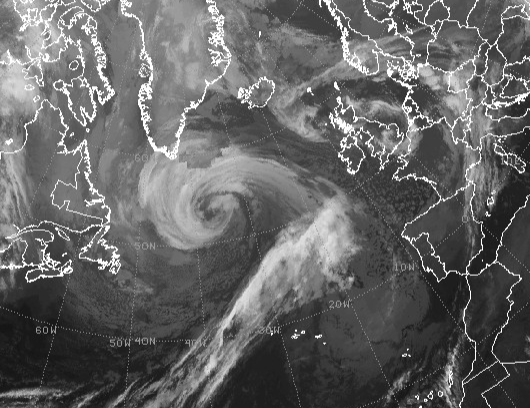
An intense 947mb hurricane force storm low over North Atlantic well east of Newfoundland is moving northeast at 15 knots.  Currently winds of 65-85 knots extend outward 120 NM south of the center with seas to 40 feet (about 12 meters). Also, within 180 NM northwest of the center winds are 50-65 knots with seas to 32 feet (about 10 meters).

NOAA NWS ASCAT 25KM Winds

NOAA NWS ASCAT 25KM Winds

North Atlantic sat 1

Posted in Ocean Storms | Tagged , , | Leave a comment

Super Typhoon Lan approaching Japan

Super Typhoon Lan satellite image

Super Typhoon Lan satellite image

Super Typhoon Lan at 1200 UTC 21 October was center about 307 NM east-southeast of Kadena Air Force Base on Okinawa, Japan and was moving N-NE at 16 knots with max winds up to 130 knots.  Lan has a large 45 NM wide eye and hurricane force winds currently extend outward up to 95 NM while 50 knot or higher winds extend outward up to 180 NM.

Wind Field Super Typhoon Lan

Wind Field Super Typhoon Lan

Although sea surface temperatures are high, Lan is moving into an area with substantially lower total heat content and increasing wind shear so max winds are expected to weaken to  100 knots, possibly less as it approaches the east coast of Honshu 22nd 1800-2100 UTC.

JTWC track forecast for Super Typhoon Lan

JTWC track forecast for Super Typhoon Lan

Posted in Ocean Storms, Tropical Cyclones | Tagged , , , , | Leave a comment

Super Typhoon possible over western Pacific

Tropical Storm Lan satellite image from JTWC Satellite Ops

Tropical Storm Lan satellite image from JTWC Satellite Ops

Tropical Storm Lan over the western North Pacific about 186 NM northwest of Kyangel was moving slowly towards the northeast with max winds of 55 knots.  Wind shear is low, ocean temperatures are very warm at 30 C to 31 C so intensification is very likely as Lan is forecast to turn more towards the north or north-northwest reaching typhoon strength during the next 12 hours and likely super-typhoon strength within 72 hours.

JTWC Forecast Track

JTWC Forecast Track


See latest Forecast Graphic

Posted in Ocean Storms, Tropical Cyclones | Tagged , , , , | Leave a comment

Hurricane Nate Saturday Update

NOAA Visible Satellite image Hurricane Nate

NOAA Visible Satellite image Hurricane Nate

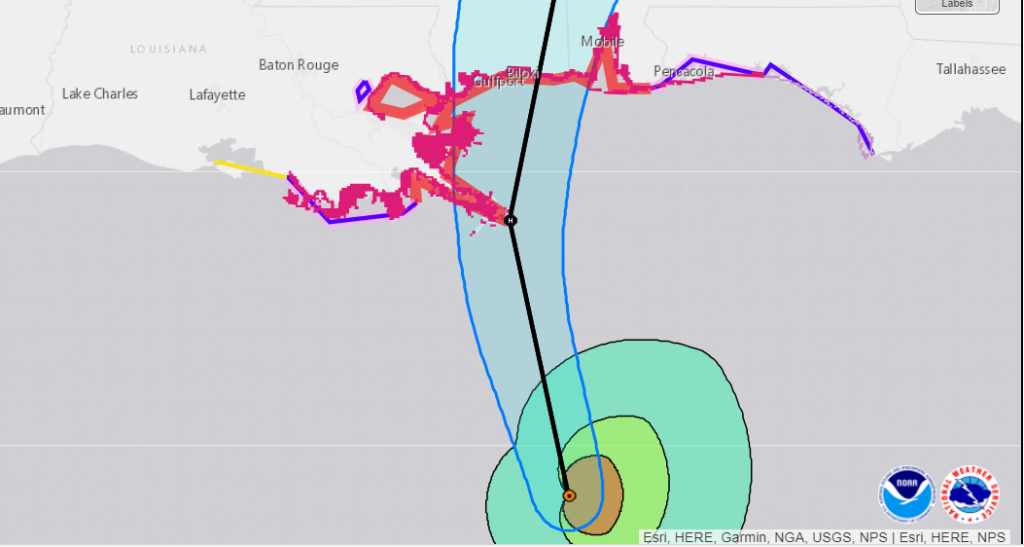
Hurricane Nate continues to intensify over the warm Gulf of Mexico as it moves rapidly toward the north-northwest at 23 knots (26 mph). Currently max winds are 80 knots (90 mph)but conditions appear favorable for Nate to continue strengthening for the next 12 hours prior to landfall.

Presently, hurricane force winds extend outward only about 30 NM on the east side of Nate with 50 knot (58 mph) or higher winds extending outward 50-60 NM but only on the east side of the storm. Maximum significant wave height is 28 feet (8.5 meters).

NOAA NHC Forecast Track Hurricane Nate

NOAA NHC Forecast Track Hurricane Nate

Nate is expected to bring life-threatening storm surge flooding near and well east of where the center makes landfall, and a storm surge warning is in effect from Morgan City, Louisiana, to the Okaloosa/Walton county line in Florida. Maximum flooding of 7 to 11 feet above ground level is expected in portions of southeastern Louisiana and along the Mississippi coast. Residents in these areas
should immediately heed any evacuation instructions given by local
officials.
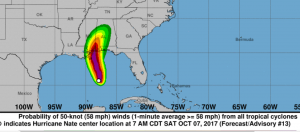
NOAA NHC forecast risk for 50 knot (58 mph) or higher winds

NOAA NHC forecast risk for 50 knot (58 mph) or higher winds

Nate is forecast to reach Category 2 intensity before landfall.
A hurricane warning is in effect for portions of the northern Gulf
Coast from Louisiana to Alabama, with the strongest winds expected
to occur primarily to the east of the center. Preparations to
protect life and property should be rushed to completion in these
areas, as tropical storm conditions will first arrive in the warning
area this afternoon.

Nate’s fast forward speed after landfall will bring tropical-
storm-force winds well inland across portions of the southeastern
U.S. Tropical storm watches and warnings are in effect for portions
of southeastern Mississippi, Alabama, and western Georgia.

Nate will bring heavy rainfall of 3 to 6 inches with isolated
totals of 10 inches east of the Mississippi River from the central
Gulf Coast into the Deep South, eastern Tennessee Valley, and
southern Appalachians through Monday, resulting in the potential for
flash flooding in these areas.
NOAA close up track forecast

NOAA close up track forecast

Radar Loop:

Posted in Ocean Storms, Tropical Cyclones | Tagged , , , , , | Leave a comment

Tropical Storm Nate Upate

NOAA Visible Satellite Image TS Nate

NOAA Visible Satellite Image TS Nate

Tropical Storm Nate is poorly organized with max winds of about 45 knots (50 mph) located 50 nm from the center and was moving just west of north at 18 knots.

Nate is expected to move quickly north-northwestward for the next 36 hours then turn more towards the north, then northeast. The center of Nate should pass near or over the northeastern tip of the Yucatan Peninsula later today or this evening followed by landfall on the northern Gulf Coast in about 36-48 hours.

NHC Forecast Track for TS Nate

NHC Forecast Track for TS Nate

Conditions appear favorable for strengthening and Nate is expected to make landfall there as a hurricane, however, the fast motion of Nate should limit development somewhat. Life-threatening storm surge flooding is likely along portions of the northern Gulf Coast, and a storm surge warning has been issued from Morgan City, Louisiana, to the Alabama/Florida border. Current forecasts suggest landfall between Buras,LA and Mobile, AL.

Risk for encountering 50kt (58mph) or higher wind

Risk for encountering 50kt (58mph) or higher wind

Posted in Ocean Storms, Tropical Cyclones | Tagged , , , , | Leave a comment

What is the weather like cruising the Caribbean in October?

Pub. 106 Atlas of Pilot Charts North Atlantic Ocean (including Gulf of Mexico), 2002 Ed.

Pub. 106
Atlas of Pilot Charts North Atlantic Ocean (including Gulf of Mexico), 2002 Ed.

October is an excellent month to cruise the Caribbean Sea.  Generally, winds are light to moderate coming primarily from the east and averaging 7-16 knots with the risk for encountering gale force or higher winds are 1 percent or less.  Gales, when they do occur, are associated with hurricanes which can and do occur this month, mostly over the western Caribbean, eastern Gulf of Mexico and the waters east of Florida and near the Bahamas.  Overall, the risk for encountering rough seas (over 12 feet) is generally 10 % or less.

During the month of October, the most active area for tropical cyclones is the northwestern Caribbean Sea, the eastern Gulf of Mexico and the waters east of Florida to the Bahamas. In these areas there is a risk of 30-40% of having a tropical cyclone pass over at least once during the month.  Over the eastern Caribbean Sea the risk is 15% or less.

Air temperatures remain warm, averaging 27-28 C  (80-83 F) while sea temperatures average 28-29 C (82-84 F).

Pilot Chart October for Gulf of Mexico and Caribbean Sea

Pilot Chart October for Gulf of Mexico and Caribbean Sea

Posted in Climatology, Cruise Weather | Tagged , , , , , | 7 Comments