Tropical Storm Philippe Strengthens Slightly, Turns Westward

Tropical Storm Philippe Satellite image

Tropical Storm Philippe has strengthened slightly to 45 kt max winds as it moves west at 8 kts.


The intensity forecast is somewhat uncertain so it is possible Philippe could maintain its tropical cyclone status as it reaches the northern Leeward Islands.

Risk for Tropical Storm Force winds (34 kt/39 mph)

The official track forecast has been shifted southward in 3-5 days which likely would bring the effects of Philippe to the northern Leeward Islands, the U.S and British Virgin Islands, and Puerto Rico with heavy rain and gusty winds.


Heavy rainfall of 2 to 4 inches of rain is likely across the northern Leeward Islands, the Virgin Islands, and eastern Puerto Rico Friday through Monday. Across western Puerto Rico, 1 to 2 inches of rain is expected. Heavy rainfall from Philippe may produce isolated urban and small stream flooding impacts.

Latest Advisory

Ocean Weather Services


Posted in Cruise Weather, North Atlantic, Ocean Storms, Tropical Cyclones | Tagged , , , , | Leave a comment

Tropical Storm Philippe Weakens

NOAA Satellite Image Tropical Storm Philippe

Tropical Storm Philippe continues to struggle with strong west-southwesterly wind shear and currently has max winds of 40 kts. 


The  low-level center is completely exposed and deep convection remains well to the east of the center.  

NOAA NHC Forecast Track TS Philippe

Continued wind shear and dry air entrainment should weaken Philippe to a tropical depression or remnant low in about 72 hrs as it moves west-northwest to west northward of the Caribbean. 

Latest Advisory

Ocean Weather Services


Posted in North Atlantic, Ocean Storms, Tropical Cyclones | Tagged , , , | Leave a comment

Tropical Storm Ophelia approaching North Carolina Coast

IR Satellite TS Ophelia

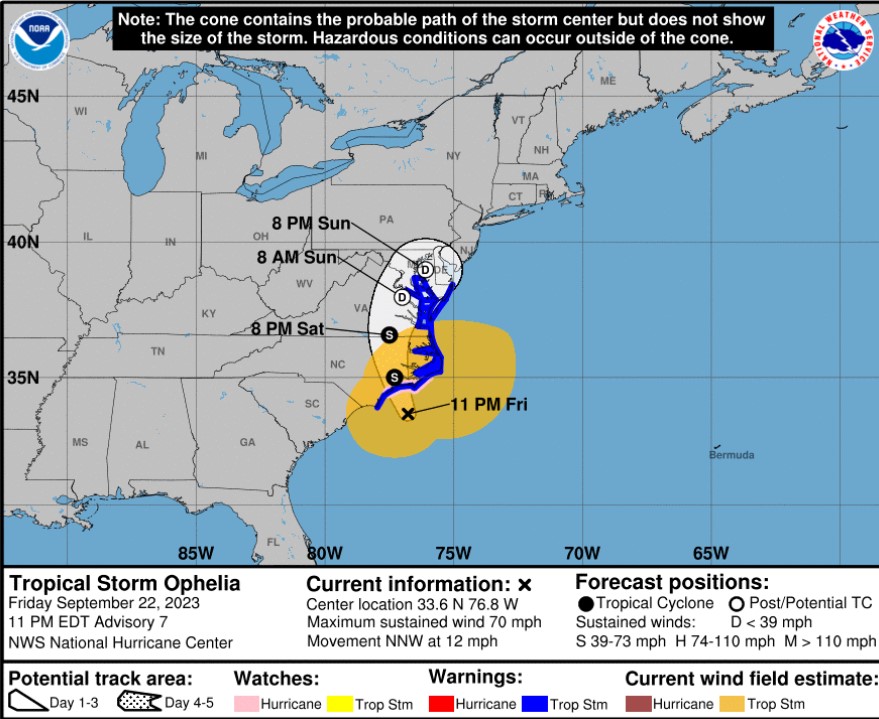
Tropical Storm Ophelia has strengthened to max winds of 60 knots and is moving north-northwestward (330 degrees) at 10 kt.  Max significant wave heights are estimated near 8.5 meters (28 feet). The current track will take Ophelia’s center inland over North Carolina on Saturday, and then across portions of southeastern Virginia and the Delmarva Peninsula Saturday night and Sunday. There is a chance Ophelia could briefly reach hurricane strength just prior to landfall.

Weakening is expected once the center moves inland Saturday morning and the winds should drop below tropical storm force between 24 and 36 hours while Ophelia is over southeastern Virginia.

NHC Track Forecast

Tropical storm conditions are expected along portions of the southeastern and  mid-Atlantic U.S. coasts through Saturday night. There is a danger of life-threatening storm surge inundation over portions of eastern North Carolina and southeastern Virginia, including Pamlico and Albemarle Sounds, the Neuse and Pamlico Rivers, the lower James River, and the lower Chesapeake Bay.


Heavy rainfall from this system could produce locally considerable flash, and urban flooding impacts across portions of the Mid-Atlantic states from North Carolina to New Jersey through Sunday.

Risk for 50 Knot (58 mph winds


Latest Advisory 

Ocean Weather Services


Posted in High Waves, North Atlantic, Ocean Storms, Tropical Cyclones | Tagged , , | Leave a comment

NOAA Upgrades Storm off US Southeast Coast to Tropical Storm Ophelia

TS Ophelia Satellite Image

2pm EDT Update:

The NHC has reclassified the developing coastal storm as “Tropical Storm Ophelia”.

Data from the Air Force Reserve Hurricane Hunters and satellite wind data indicate that maximum sustained winds have increased to near 50 knots (60 mph) with some slight strengthening still  possible before landfall along the coast of North Carolina early Saturday morning.  Significant wave heights currently 6-8 meters (20-26 feet).

Current satellite image suggests that Ophelia looks more like a subtropical system than a tropical system with most to the wind and clouds northwest and north of the center. 

STORM SURGE

The combination of a dangerous storm surge and the tide will cause normally dry areas near the coast to be flooded by rising waters moving inland from the shoreline.  The water could reach the following heights above ground somewhere in the indicated

Areas if the peak surge occurs at the time of high tide:
Neuse and Bay Rivers…3-5 ft
Pamlico and Pungo Rivers…3-5 ft
Chesapeake Bay south of Colonial Beach…2-4 ft
Surf City, NC to Chincoteague, VA…2-4 ft
Albemarle Sound…2-4 ft
South Santee River, SC to Surf City, NC…1-3 ft
Chincoteague, VA to Manasquan Inlet, NJ…1-3 ft
Upper Chesapeake Bay…1-3 ft
Delaware Bay…1-3 ft

NHC Forecast Track

Latest Advisory from NHC

Ocean Weather Services

Posted in Floods, North Atlantic, Ocean Storms, Tropical Cyclones | Tagged , , , , | Leave a comment

Potential Tropical Cyclone 16 heading for North Carolina Coast

Satellite Image Potential Tropical Cyclone 16

A deepening Gale low off the US Southeast Coast is moving north at 10 kts with max winds to 45 knots with significant wave heights to 6.5 meters (21 feet). Gale force winds extend out 210-240 nm north of the center and 60 nm to the southwest. Some additional strengthening is possible prior to landfall over eastern North Carolina on Saturday morning, followed by weakening and finally dissipating over Maryland Sunday. The low is currently extratropical, but has some subtropical characteristics.

NOAA Surface Analysis

Tropical storm conditions are expected along portions of the southeastern and mid-Atlantic U.S. coasts within the Tropical Storm Warning area today into Saturday night.

There is a danger of life-threatening storm surge inundation over portions of eastern North Carolina and southeastern Virginia, including Pamlico and Albemarle Sounds, the Neuse and Pamlico Rivers, the lower James River, and the lower Chesapeake Bay, where Storm Surge Warnings are in place. 


Heavy rainfall from this system could produce flash, urban, and small stream flooding impacts across portions of the Mid-Atlantic states from North Carolina to New Jersey through Sunday.

NHC Forecast Track


Latest NOAA NHC Advisory  

Ocean Weather Services

Posted in High Waves, North Atlantic, Ocean Storms, Tropical Cyclones | Tagged , , , , | Leave a comment

Hurricane Nigel now transitioning into an Extratropical Storm Low

Hurricane Nigel is moving rapidly northeastward and now undergoing extratropical transition this evening with max winds to 65 knots and max significant waves to 13 meters (43 feet).

NOAA OPC Surface Analysis

Nigel will become an intense storm low over the east-central North Atlantic Friday and Saturday with max winds of 55-60 knots and significant wave heights to 10 meters (33 feet).

NOAA OPC Surface Forecast 23 Sept. 1200Z

Ocean Weather Services


Posted in High Waves, Hurricane-Force, North Atlantic, Ocean Storms | Tagged , , , | Leave a comment

Hurricane Nigel Encountering Wind Shear

Hurricane Nigel IR image

Hurricane Nigel is encountering wind shear and the eye is now open to the northeast, however, it  still is maintaining a max wind of 85 knots with significant wave heights to 10 meters (33 feet). Nigel is moving toward the north at 13 knots, but should turn northeastward during Wednesday and accelerate. 


Some short-term strengthening is still possible, however, in a couple of days,Nigel will be moving over colder sea temperatures with increasing wind shear which should steadily weaken the storm, finally transitioning into an extratropical low within 72 hours.

Hurricane Nigel Official Track Forecast from NOAA NHC


Latest Advisory on Nigel 

Ocean Weather Services


Posted in North Atlantic, Ocean Storms, Tropical Cyclones | Tagged , , | Leave a comment

High Waves Pound South Africa’s Coastline

Massive Waves Pound Harbour House Restaurant in Kalk Bay  Image Link

High waves of 7-9.5 meters (23 to 31 feet) crashed into parts of South Africa’s coastline over the weekend, generated by a 952 mb storm low to the south. Buildings and vehicles were damaged and at least two deaths are being connected to the high surf.


Damage was reported from the outskirts of Cape Town in the southwest to as far as the eastern coast of the KwaZulu-Natal province.

Significant Wave Heights Saturday Sept. 15th


Farther to the south near the storm center, wave heights were up to 14 meters (46 feet).

Storm Low Saturday 16 Sept. 2023


Ocean Weather Services

Posted in High Waves, Ocean Storms, Ocean Weather, Storm Surge | Tagged , , , | Leave a comment

Tropical Storm Nigel expected to Rapidly Deepen

Tropical Storm Nigel

Tropical Storm Nigel has formed over the central North Atlantic near 25.1 N, 49.5 W, and was moving northwest at 11 knots with max winds to 55 knots. Max significant wave heights currently estimated near 6 meters (19-20 feet).


Nigel is forecast to continue moving northwest during the next few days in a very favorable environment and rapid intensification is likely. Nigel will likely reach hurricane strength within the next 12 hours, reaching near 100 knot max winds in about 36 hours with max significant wave heights increasing to near 10 meters (30-35 feet). After about 72 hours, Nigel will turn north then northeast and accelerate and weaken while transitioning into an extratropical system.

Offical NHC Forecast Track


Latest NHC Advisory

Ocean Weather Services


Posted in North Atlantic, Ocean Storms, Tropical Cyclones | Tagged , , , | Leave a comment

Hurricane Lee Heading for Landfall in Atlantic Canada

Hurricane Lee Visual Satellite

Hurricane Lee remains a very large hurricane over the western Atlantic with max winds near 70 knots and moving north-northeast at 16 knots. 

Hurricane force winds extend out 90 nm to the northeast and 70 nm to the southwest.  50 knot winds extend out 160-170 nm to the east and 110-150 nm to the west.  Maximum significant wave heights are estimated near 14 meters (46 feet).

Lee is expected to make landfall in Atlantic Canada in 24 to 36 hours.  After landfall, Lee is forecast to accelerate to the northeast. Wind shear and colder sea temperatures will weaken Lee which is forecast to become extratropical by landfall with max winds of 55-60 knots.

NOAA NHC Hurricane Lee Forecast Track

Heavy rainfall from Lee could produce localized urban and small stream flooding in eastern Maine into portions of New Brunswick and Nova Scotia from tonight into Saturday night.

A Hurricane Watch is in effect for:  New Brunswick from the U.S./Canada border to Point Lepreau, including Grand Manan Island, Nova Scotia from Digby to Ecum Secum.

A Tropical Storm Warning is in effect for: Bermuda, Westport Massachusetts northward to the U.S./Canada border, Martha’s Vineyard, Nantucket, New Brunswick from the U.S./Canada border to Fort Lawrence, including Grand Manan Island, Nova Scotia from Fort Lawrence to Point Tupper.

Risk for Wind Speeds of 50 knots (58 mph)

Risk of encountering damaging 50 knot (58 mph) winds currently are:

Nantucket:  near zero
Bar Harbor: less than 5%
Eastport:  30-35%
St John, NB: 45 %
Yarmouth, NS: 70-75%
Halifax, NS: 5-10%

Latest NOAA NHC Advisory

Ocean Weather Services

Posted in Hurricane-Force, North Atlantic, Ocean Storms, Tropical Cyclones | Tagged , , , , , , | 1 Comment